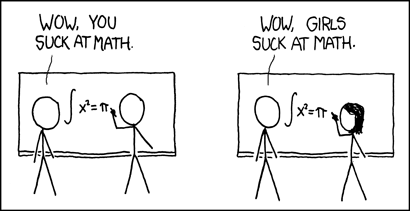
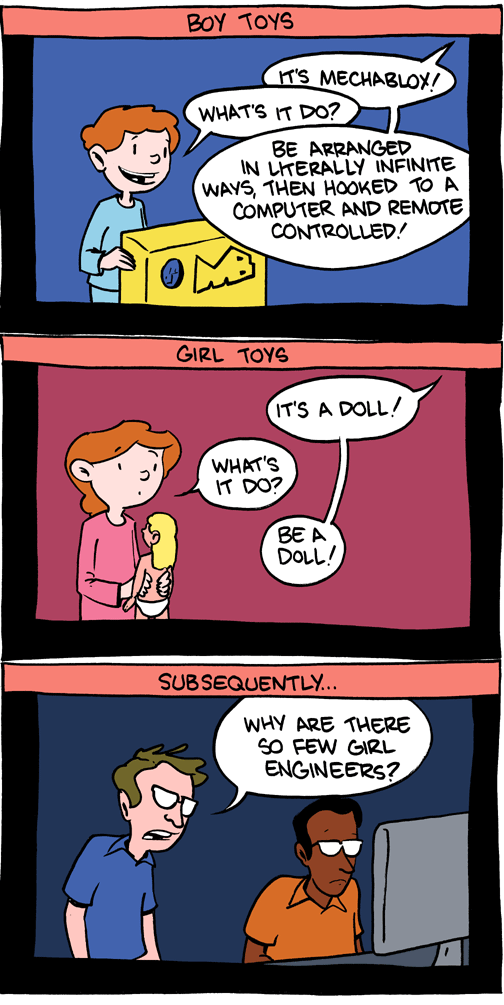
Your subconscious, that monster
The inability of people to understand how much their subconscious influences their behavior never ceases to baffle me. Sure, they accept the idea of a subconscious in the abstract, but they will never admit that a certain behavior of theirs might have been influenced by it. I suspect the lack of total control over their thoughts and motivations scares them so much they react with denial.
No, the fact that you don’t consciously hold sexist, racist, homophobic views, does not mean that you actually treat everyone equally. Because, subconscious bias.
No, the fact that someone else treated people differently because of their sex, race, sexual orientation etc does not necessarily make them an entitled asshole, so stop crying “How can people be like that?” and asking for their head on a platter. Chances are they are just as unaware of their subconscious biases as you are.
In general, your subconscious is a dick. If it were a person, you would never want to hang out with them. It judges everyone and everything by stereotypes. Its intentions are good: it’s trying to help you save time, which in the jungle could mean the difference between life and death. But in our domesticated society, it can make you act unfairly towards others. So, I call it “the subconscious monster”.
I will focus on internalized sexism for the rest of this post, but any of the following really applies to any kind of long-standing bigotry.
Feminism has come a long way over the past few decades, but gender bias still exists. We see it in study after study after study. It’s really hard to fight this “leftover” sexism, because it’s mostly subconscious. Only few fundamentalist nutjobs will flat out say that women are inferior or that they should have “different roles”, everyone else believes they are an egalitarian snowflake and is unable to spot any bias in their thinking even when it’s staring them in the face.
We almost all have such biases since we grew up in a patriarchal society. Humans learn about the world by pattern matching, and we grew up seeing women relegated to the sidelines everywhere: in business, in pop culture, in the home. That’s a ton of patterns our brains have been feeding on, for decades. Even worse, women also grow up with these patterns and often reproduce them, increasing the predictive accuracy of these internalized stereotypes, which makes our subconscious monsters less willing to drop them (think of how many women still get their husband’s last name, happily reproducing a tradition that stems from a time where they were seen as property).
So how do you fight internalized sexism? Before you go out trying to enlighten and change others, try to fight it in yourself. How? With a lot of introspection. You need to accept that you probably have it, and be alert for when it manifests. Even just that works wonders over time. A good trick to catch your subconscious monster in the act is to try reversing the genders of people in a situation. For example, if you find yourself thinking that Mary is being pompous and arrogant, try to imagine the same things being said by John. Does he also sound pompous and arrogant or did he suddenly become confident and assertive instead? It doesn’t always work, because the subconscious monster is sneaky and resilient, but if you’re honest with yourself, it works often enough that the results will surprise you.
Secondly, try to fight it in the next generation, by not perpetuating even more of these patterns. This is why seemingly unimportant things like gender neutral language or jokes and pop culture matter: because the subconscious is a pattern-hungry monster and it will gladly feed off any hint that one gender might be less important than the other, so long as said hint is sufficiently widespread. If you use “he” as a default, your subconscious monster thinks that “she” is the exception, an oddity. Given that language used “he” as the default for so long, it’s no surprise that people tend to imagine doctors, professors, lawyers etc as male, even in cases where female would have been more likely. The pronouns in the language translate to concepts in our head, and then things like the Smurfs happen, where every (male) smurf has a skill, except Smurfette, whose skill is …being a woman.
Even if you do a lot of work with yourself and strive to get rid of your own subconscious biases, everyone else will still have theirs. And most of them are not as enlightened as you, and will not have done any work with themselves to fight it or even acknowledge it. This can be very frustrating: once you start noticing, you cannot un-notice. When you tell them that they said or did something sexist, they will become extremely defensive because in their head, you accused them of conscious sexism, and as we all know people who are consciously sexist are Huge Assholes™.
So what do you do if you witness sexist behavior by someone unaware of their bias? You point it out to everyone and call them an asshole, that will teach them, right?? Wrong.
Here’s a meta-description of practically every sexism-related Twitter shitstorm I have observed: dude says something sexist without realizing, the Internet explodes, everyone curses at him, he gets fired from his job and nobody loves him anymore. His takeaway? “People are crazy these days, everything is so politically correct. I did nothing wrong. I should just stay quiet in the future”. The takeaway of many, many onlookers? “People are crazy these days, everything is so politically correct. He did nothing wrong. I should stay quiet in the future so the same thing doesn’t happen to me”. Nobody learned anything from this. From their perspective, they said something innocuous and it was blown out of proportion. The angry crowd is temporarily satisfied, but no social progress has been made.
If anything, such incidents cause societal regression instead of progress. They make it harder to teach people to recognize their subconscious bias, because if they never feel comfortable to express their thoughts, nobody can comment on them anymore. They still however influence their actions, and it’s really the actions we want to change. Men also start avoiding talking to women at conferences and the workplace because they perceive it as too high-risk, which effectively puts obstacles on their careers, especially in male-dominated fields.
I dream of a society where everyone accepts that they have internalized biases and is alert about their manifestation both in themselves and others. A society where we would all work together to reach equality, instead of trying to find the next enemy and burn them at the stake. Imagine if you could calmly tell someone “hey, that was sexist”, and instead of them getting defensive because they know that accepting it would mean social and professional suicide, they could just reply “damn, it got me again! Thanks, I’ll introspect about it” and does so.
What can we do until we manage to reach this level of social Zen? Perhaps we can work towards it, by educating other people about subconscious bias and being less vitriolic when they get things wrong. In most cases it’s well-meaning people that were tricked by their subconscious monster, not real chauvinistic pigs. As with most situations, empathy usually works much better than rage, even if it’s less satisfying in the short run.
Lastly, the fact that most sexism these days is subconscious makes it really hard to detect. We know it exists because it shows up in large numbers and statistics, whether that’s a controlled lab study or every woman’s experiences throughout her life. But it can often be impossible to tell if an individual incident is motivated by sexism or not. If a woman was not hired, is it because of her gender or her skill? If someone is explaining to me something I already know, are they mansplaining or would they explain it to a man as well? Nobody knows, not even the person making the hiring decision or the explaining! This can easily drive people paranoid, making them see sexism everywhere or missing it even when it’s staring them in the face, depending on which side they choose to err on. I usually try to give people the benefit of the doubt, but I do wonder, every time. This is a kind of cognitive load that people who don’t belong in a frequently discriminated against group* don’t ever have to deal with.
I wish I could end this post with an upbeat call to action, but I’m afraid I don’t really have one. I don’t see any other solution besides the long slow process of introspecting, raising awareness, and, perhaps most importantly, making sure the next generations see fewer sexist patterns around them to match on. Most of the efforts to fix it Right Now™ that I have seen end up being messy patches instead of real cures, and cause even more stereotyping. But if we want to have a shot at finding a solution, the first step is to really understand the problem, right?
* No, I’m not gonna use “straight white male” instead of this. There are plenty of straight white males that are discriminated against, due to their age, religion, country of origin, native language, class, or a myriad of other reasons. Discrimination is not just about sex, race, and sexual orientation, despite America’s narrow fixation on that particular subset of diversity.