
Dear JS ecosystem, I love you, but you have a dependency management problem when it comes to the Web, and the time has come for an intervention.
Abstraction is the cornerstone of modern software engineering. Reusing logic and building higher-level solutions from lower-level building blocks is what makes all the technological wonders around us possible. Imagine if every time anyone wrote a calculator they also had to reinvent floating-point arithmetic and string encoding!
And yet, the web platform has outsourced this fundamental functionality to third-party tooling. As a result, code reuse has become a balancing of tradeoffs that should not have existed in the first place.
In NodeJS, you just npm install and reference specifiers straight away in your code.
Same in Python, with pip install.
Same in Rust with cargo add.
In healthy ecosystems dependencies are normal, cheap, and first-class.
You just install them using the one standard way, use them, and move on.
You don’t have to ponder which third-party tool to use, or — worse — whether to use dependencies at all.
“Dependency-free” is not a badge of honor.
Instead, dependency management in the web platform consists of bits and bobs of scattered primitives, with no coherent end-to-end solution. Naturally, bundlers such as Webpack, rollup, and esbuild have picked up the slack, with browserify being the one that started it all, in 2012.
Dependencies are too essential to be outsourced
On a very high-level, there are four things a bundler does for you:
- Performance optimizations: e.g., tree-shaking, prerendering, code splitting, minification, etc
- Transpilation / Templating, parsing one syntax and converting it to another. This includes templating, JSX, CSS preprocessing, TypeScript compilation, etc
- Dependency management. Making it possible to use libraries installed via package managers like npm or yarn
- Debugging improvements: Hot reloading, source maps, etc.
One of these is not like the others. Can you tell which one?
Performance, debugging improvements, and transpilation are generally advanced concerns. They are QoL improvements, but you can get quite far without them.1The only exception is perhaps HTML includes, which are already being prototyped in Chrome 🎉.
But dependencies? Dependencies are essential! You don’t want to be writing your own drag and drop library, UI components, icons, charting library, and so on. In the vast majority of websites or libraries, the need for dependencies comes up in the first few lines of code.
Do you see the problem now? Requiring complex tools for complex needs is totally fine! But when you need complex tools for basic needs, that’s a smell that something is seriously broken in the ecosystem. Dependency management is such a basic and ubiquitous need, it should be a part of the platform, decoupled from bundling.
Bundling is not technically a necessary step of dependency management. Importing files through URLs is natively supported in every browser, via ESM imports. HTTP/2 makes importing multiple small files far more reasonable than it used to be — at least from a connection overhead perspective. Sure, a bundler will always win on first load, as it knows far more about your app than the browser ever could. But that is precisely the kind of optimization you should be able to layer on later, not the price of admission. You can totally get by without bundlers in a project that doesn’t use any libraries.
But the moment you add that first dependency, everything changes. You are suddenly faced with a huge usability cliff: which bundler to use, how to configure it, how to deploy with it, a mountain of decisions standing between you and your goal of using that one drag and drop library. A meta-framework does take the thought out of this, which is how we end up with websites using Next.js for a simple landing page.
Dependency management is one of the web platform’s usability cliffs: a small increase in use case complexity results in a large increase in system complexity.
How did we get here?
Many of us old farts often reminisce about the good old days: the simplicity of editing a file and seeing the result, no build step, no watcher, no configuration. But that carefully leaves out the numerous things that downright sucked, and dependency management was chief among them.
Remember when every dependency was basically a peer dependency, and you had to manually add <script> elements, not just for every dependency, but for their dependencies too?
And get the order right?
And good luck if two of them needed different versions of the same library — who remembers jQuery.noConflict()?
I won’t even get into how versioning was done, to protect your sanity.
You young’uns have no idea how good you have it.
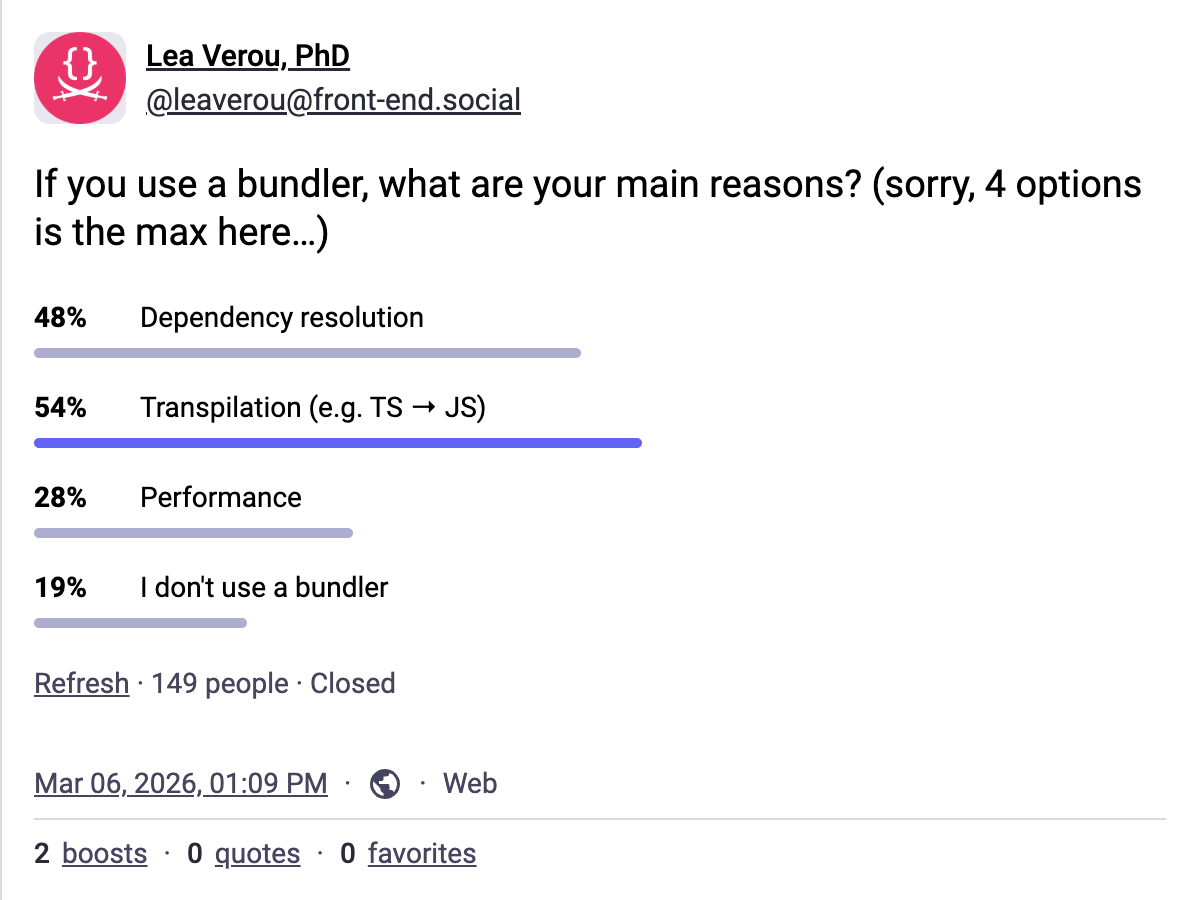
Bundlers gave us the DX of the NodeJS ecosystem: npm install and then you just import.
The performance optimizations, debugging affordances, and transpilation were a nice cherry on top, but they are not what drove adoption.
Dependency management is also the hairiest of the four, because it has tentacles over everything. We had been transpiling and optimizing code with separate build scripts since the beginning of time, and that was never a problem: TS becomes JS and is then handled like regular JS. SCSS becomes CSS and is then handled like regular CSS. Nothing else in the codebase needs to know. But every part of the codebase needs to know how the repo manages dependencies. That is what drove monolithic bundlers to ubiquity: not performance, not transpilation, but the one basic need the platform never covered.
Don’t look at usage, look at sentiment
Asking developers whether they use a bundler is the wrong question. Of course they do. You can’t survive without it! Per State of JS 2024, Webpack alone has been used by 9 in 10 developers, with close to 100% awareness. Even CodePen had to add bundler support, because even small testcases and experiments are a pain without one.
Instead, try asking them how they feel. Despite the ubiquity of bundlers, “managing dependencies” was still No 3 in the State of JS pain points, right after “Code architecture” and “State management”!
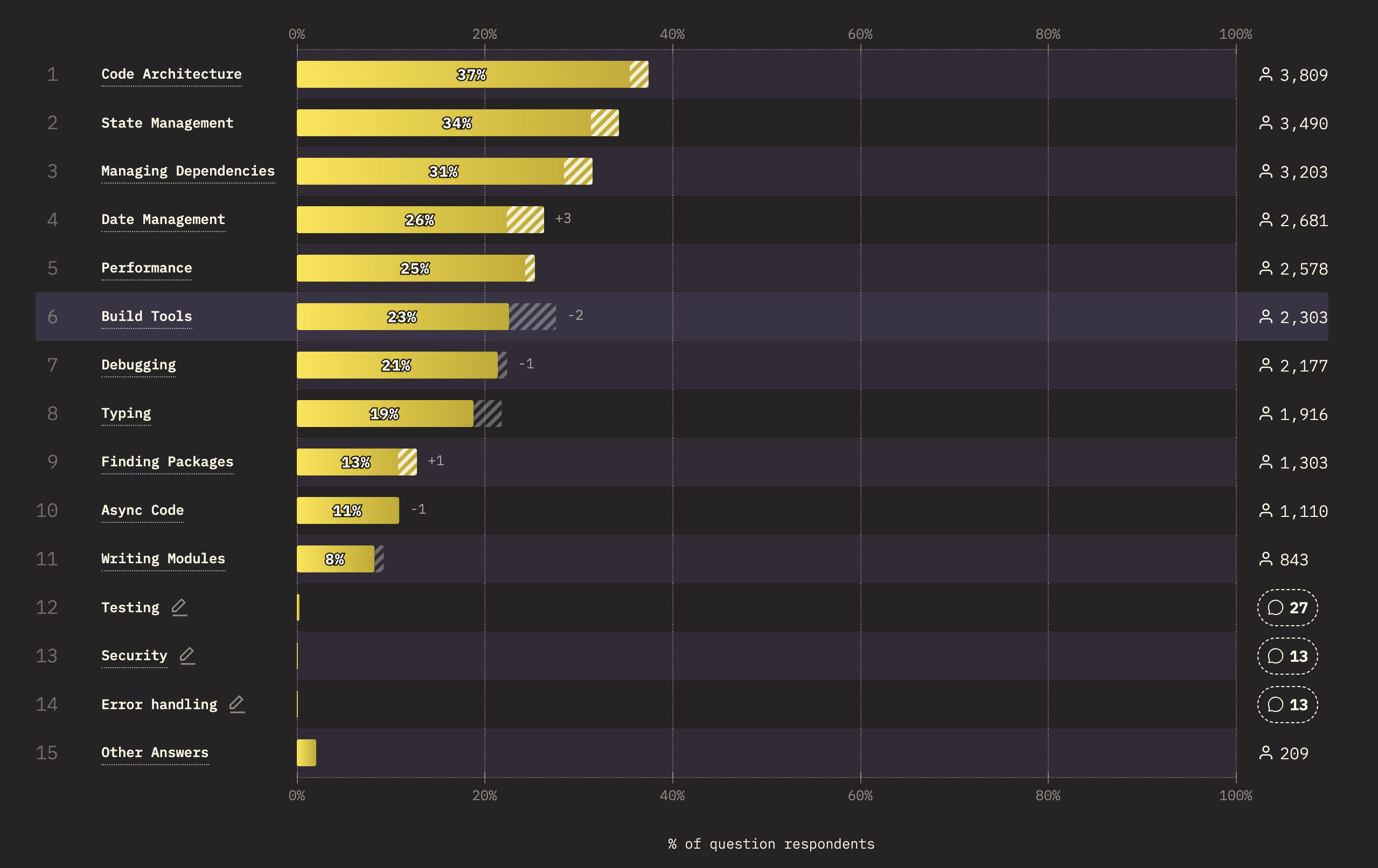
And sorting the State of JS build tool data by sentiment paints a very different picture than usage does, with satisfaction, interest, and positivity dropping year after year. Even those who never question the status quo can feel it in their gut that this is not okay.
So I asked point blank: do you use a bundler, and do you wish you didn’t?
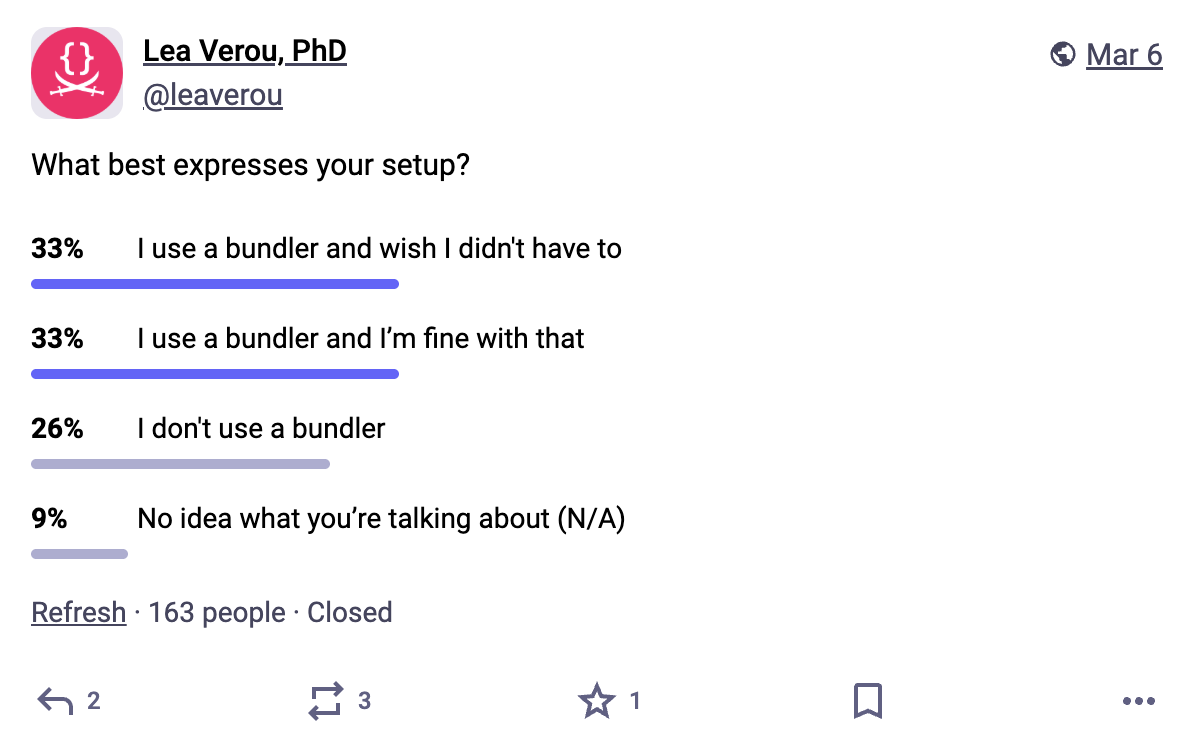

Social media polls, run in March 2026. Yes, most developers use a bundler (88% on Twitter, 72% on Mastodon), but a pretty high percentage wishes they didn’t (a third of bundler users on X/Twitter and half on Mastodon).
A third to half is a pretty high amount of dissatisfaction! And when I had asked back in January, I was surprised to see how many had skipped bundlers altogether: 17.6% on Twitter/X and 40% (!) on Mastodon. Obviously, all of these suffer from selection bias, due to the snowball sampling nature of social media, but the pattern is consistent. I’m very curious how these folks manage the problems discussed below.
Anecdotally, from my conversations with developers, it seems the rest have simply resigned to the complexity in the same way one resigns to paying taxes, and just accept the status quo as the price to pay to deploy a website. Like boiling frogs, JS developers have resigned themselves to immense levels of complexity and gruntwork as simply how things are. The rise of AI introduced swaths of less technical folks to web development and their overwhelm and confusion is forcing us to take a long hard look at the current shape of the ecosystem — and it’s not pretty.
Dependencies without bundlers, today?

It is technically possible to use dependencies without bundlers, today. There are a few different approaches, and — I will not sugarcoat it — they all suck.
Fundamentally, there are two ways to reference a dependency: by URL or by specifier. URLs can be local (a path in your project) or remote (a CDN). Specifiers need something to map them to URLs, which today means import maps. There is currently no good answer for any of these, only fragile workarounds held together by duct tape.
Using a dependency should not need any additional song and dance besides “install this package” + “now import it here”. That’s it. That’s the minimum necessary to declare intent. And that’s precisely how it works in NodeJS and other JS runtimes. Anything beyond that is reducing signal-to-noise ratio, especially if it needs to be done separately for every project or worse, for every dependency.
You may need to have something to bite hard on while reading the next few sections. It’s going to be bad.
Path-based solutions
Typically, package managers like npm take care of deduplicating compatible package versions and may use a directory like node_modules to install packages.
Some developers notice this and try rawdogging node_modules/ imports:
import { createApp } from "../node_modules/vue/dist/vue.esm-browser.js";
Eek. It works (in some cases), but deploying your entire node_modules directory is both wasteful, and a security risk. In fact, most serverless hosts (e.g. Netlify or Vercel) automatically remove it from the publicly deployed files after the build is finished, which means you need additional code to reinstate it or rewrite these imports.
Others have tried isolating the packages they actually need and copying them into a separate directory:
{
	"scripts": {
		"lib": "cp node_modules/vue/dist/vue.esm-browser.js common/lib/vue.js",
		"build": "npm run lib"
	}
}
It’s a little better than the former, but now you need to keep track of what packages each package imports and copy them too. Yikes!
But zooming out, both of these approaches are severely problematic, for two bigger reasons.
First, they break transitive dependencies. This may work fine when you’re vendoring packages with no dependencies of their own, but the moment you use a package that uses another package, it all collapses like the tower of cards it is. Even if you were willing to hunt down which of your packages use dependencies and vendor those too, how would the packages even reference them? They have no idea what your directory structure looks like. Unless, of course, you’re willing to rewrite the files you’re copying — but now you’re building your own bundler. Please don’t. And even if a package uses no dependencies today, that may change tomorrow, so instead of building whatever it is you’re building, you’re now monitoring your dependencies’ dependencies.
As someone who regularly releases open source packages (some with billions of npm installs), I find this incredibly frustrating. I want to write packages that can be consumed by people using whatever they want to manage their dependencies, but the only way to do that today is to basically not use any dependencies. I cannot even modularize my own packages without running into this! This doesn’t scale. The creator of htmx reached the same conclusion, and committed to not using dependencies so that their users can vendor htmx. This is an awful compromise that no library author should be forced into.
Specifiers are an essential abstraction
Second, any path-based solution breaks encapsulation.
There is a reason why we reference packages using specifiers like vue or lit instead of URLs to the actual files.
Specifiers are an abstraction over URLs, but an essential one for dependency management. We don’t use specifiers instead of URLs because they look a little prettier. We use them because they decouple a dependency from:
- the exact location of the package
- the exact file path within the package (which often changes between versions)
- the exact version, for the source referencing (different packages may import different versions of the same dependency using the same specifier)
- the import conditions (e.g. browser, node, types, etc)
Worse, without specifiers, transitive dependencies have nothing reasonable to reference.
Specifiers should be non-negotiable. You should never have to track what the specifiers of your dependencies map to and update your code when they change. Seriously, if you find yourself doing that, take a long hard look in the mirror and ask yourself where things went wrong. Any dependency management system that forces you to write out paths manually should be a non-starter, period. The cost-benefit is just not there.
Importing from public CDNs
Another common path is importing from CDNs like Unpkg and JSDelivr. For Vue, it may look like this:
import { createApp } from "https://unpkg.com/vue@3";
It’s quick and easy. Nothing to install or configure! Some CDNs, like esm.sh, even rewrite specifiers on the fly, so transitive dependencies Just Work™, making this the only URL-based approach that actually scales. Great, right?
No. Not great.
It is always a bad idea to introduce a dependency on a whole other domain you do not control, and an even worse one when linking to executable code.
First, there is the obvious security risk. Unless you link to a specific version, down to the patch number and/or use SRI, the resource could turn malicious overnight under your nose if the package is compromised. And even if you link to a specific version, there is always the risk that the CDN itself could get compromised. Who remembers polyfill.io?
But supply-chain attacks aside, any third-party domain is an unnecessary additional point of failure. I still remember scrambling to change JSDelivr URLs to Unpkg during an outage right before one of my talks, or having to hunt down all my repos that used RawGit URLs when it sunset, including many libraries.
The DX is also suboptimal.
You lose the immediacy and resilience of local paths.
Without additional tooling (Requestly, hosts file edits, etc.), you now need to wait for CDN roundtrips even during local development.
Wanted to code on a flight?
Good luck.
Needed to show a live demo during a talk, over clogged conference wifi?
Maybe sacrifice a goat to the gods. 🐐
There is a subtler problem too.
Specifiers don’t just abstract over locations, they also enforce consistency across the codebase: import "marked" means the same thing in every file of your project.
With URLs, nothing stops foo.js from importing marked@18 while bar.js imports marked@17, and you end up shipping both, possibly even from different CDNs.
Multiple versions of the same dependency can coexist, but that should be a deliberate choice, not accidental drift.
And with AI defaulting to local edits, cross-codebase consistency is now more important than ever.
“But with public CDNs, I benefit from the resource having already been cached by another website the user visited!”
Oh my sweet summer child.
I hate to be the one to break it to you, but no, you don’t, and that has been the case since about 2020.
Double keyed caching obliterated this advantage.
Import maps to the rescue?
Browsers can import specifiers, as long as the mapping to a URL is explicitly provided through an import map. Import maps look like this:
<script type="importmap">
{
	"imports": {
		"vue": "./node_modules/vue/dist/vue.runtime.esm-bundler.js",
		"lodash": "./node_modules/lodash-es/lodash.js",
	}
}
</script>
Did you notice something? Yes, this is an HTML block. No, I cannot link to an import map that lives in a separate file. Instead, I have to include the darn thing in. Every. Single. Page.
“💡 Oh I know, I’ll inject it via DOM methods!” I hear you say. Yes, my sweet summer child, that actually works — as long as it’s done from a classic (non-module) script that runs before any module is fetched. It’s clunky, but it’s what lets us emulate external import maps today, and it’s what JSPM 4.0 does. So at least we can dodge the HTML templating tool. 🎉
“💡 And I’ll keep it short by routing everything through a CDN or the same local folder!” No, my sweet summer child. Go to sleep and dream of globs and URLPatterns. Then wake up and get to work, because you actually need to specify. Every. Single. Mapping. Yes, transitive dependencies too.


You wanted to use dependencies? You will pay with your blood, sweat, and tears. Or, well, another build tool.
So now I need a build tool to manage the import map, like JSPM.
There are three invariants that import maps violate:
- Locality: Dependency declarations live in one global map owned by the final consumer. A library cannot even ship a fallback mapping, so it has no way to guarantee it works outside the consumer’s setup.
- Composability: Import maps do not compose across dependencies and require global coordination
- Scalability: Mapping every transitive dependency is not viable without tooling
Plus, you still have all of the issues discussed above, because you still need URLs to link to.
Notably, JSPM’s primary flow is linking to node_modules/ on localhost and a CDN (they have their own too, that is optimized for this) in production.
If you don’t want to use CDNs in production, you’re SOL.
To sum up, import maps are not the solution, but they are an essential part of it. They give us specifiers in the browser, which is huge, but on their own they don’t eliminate the need for tooling — they just make lighter tooling possible. And a lighter build tool is still an improvement!

Are bundlers the lesser evil?
Given the current state of the ecosystem, not using bundlers in any nontrivial application does seem like an exercise in masochism. And yet, as we saw, a surprising share of developers do exactly that, and a much larger share wishes they could. This is not a reasonable way to manage dependencies. This is not a healthy ecosystem.
Oftentimes when discussing these issues, I get the question “but other languages are completely compiled, why is it a problem here?”. Yes, but their compiler is official and always there. You literally can’t use the language without it. You don’t get a broken experience, you get no experience.
The problem is not compilation, it’s fragmentation. It’s the newbie trying to use a drag and drop library, only to get mysterious errors about specifiers that failed to resolve. It’s having to add mountains of config and complexity to use a utility function. It’s having no clear path to write a package that uses another package, even if both are yours.
The problem is not compilation, it’s fragmentation.
Abstraction itself is not something to outsource to third-party tools. This is the programming equivalent of privatizing fundamental infrastructure — roads, law enforcement, healthcare — systems that work precisely because everyone can rely on them being there.
This is also actively harming web platform architecture. A general API design principle is to prioritize the needs of consumers over the needs of producers; the web platform even has its own version, the priority of constituencies. When it comes to bundlers, web developers are the consumers, so their needs should come first. But bundler ubiquity has reversed the natural order: now web developers cater to bundlers. Code that works perfectly fine in a browser has to be rewritten to work in bundlers. And because bundlers are so ubiquitous, we have ended up designing the platform around them, when it should be the opposite.
To reiterate, the problem isn’t that bundlers exist — it’s that they are the only viable way to get first-class dependency management on the web.
JS developers deserve better. The web platform deserves better.
Where do we go from here?
The web platform's specifier support feels like an arcade demo: you get to watch the first level, but there's no coin slot to play the actual game.
As a web standards person, my first thought when spotting such a lacking is “how can the web platform improve?”. And after four years in the TAG, I cannot shake the holistic architectural perspective of “which part of the Web stack is best suited for this?” The following is my take.
We need specifiers everywhere
It is clear that specifiers are an essential piece of the puzzle, for the reasons mentioned earlier. The web platform’s specifier support feels like an arcade demo: you get to watch the first level, but there’s no coin slot to play the actual game. While the web platform provides import maps to map specifiers to URLs, they only work for JS dependencies. But the Web is not just JS! What about CSS frameworks, icons, fonts, etc.?? There is no way to use specifiers for any other type of resource. You either rawdog URLs, or give up and use a bundler already.
Even for JS dependencies, specifiers don’t yet work in workers, but that’s a relatively simple fix, whatwg/html#10858 has just stalled due to lack of time.
Oh, and fun fact: they don’t even work in <script type=module src="foo">!
That foo will be interpreted as a local URL, even if you’ve defined a corresponding specifier.
Which brings me to my next point.
How could we retrofit specifiers into the web platform?
We can’t just start accepting specifiers in places designed for URLs — <link rel=stylesheet href="foo"> or @import url('foo'); already have an established meaning: they are relative URLs to the file called foo.
ESM avoided this by designing imports with specifier disambiguation from the get go.
The solutions are to either add one-off ESM-like specifier-first referencing syntax in every part of the platform that may want to import any resource from a dependency (CSS files, <script src>, CSS @import, CSS url(), SVG <use> etc etc),
or to design a new URL scheme (specifier:?) to reference them everywhere (which is what I proposed a while ago).
An advantage of that is also that it bridges the gap between specifiers and URLs.
Rather than having two entirely separate primitives for linking to a resource, it makes specifiers a high-level primitive and URLs the low-level primitive that explains it.
Improving import maps
An area with huge room for improvement here is import maps. Both making it easier to generate and include import maps, and making the import maps themselves smaller, leaner, and easier to maintain.
Note that thanks to Shopify there have been some recent improvements making import maps a lot more resilient. Unfortunately, Firefox does not yet support them, which is proposed for Interop 2027.
External import maps
The most obvious gap is external import maps, even if it’s only via <script type=importmap src>.
As we saw, they can be emulated via DOM injection from a regular JS file, which is what JSPM 4.0 does, but it’s needlessly complicated and error-prone.
Native support would make linking an import map as boring as linking a stylesheet.
This was actually part of the original import map work, and was removed from the spec due to lack of implementer interest, despite overwhelming demand from developers. In 2022, external import maps were prototyped in WebKit (Safari), which prompted a new WHATWG issue. Unfortunately, it appears that progress has since stalled once more.
Import maps without HTML?
External import maps do alleviate some of the core pain points, but are still globally managed in HTML, which hinders composability and requires heavier tooling.
What if import maps could be imported into JS code? This would eliminate the dependency on HTML altogether, allowing for scripts to localize their own import info, and for the graph to be progressively composed instead of globally managed.
Originally, I was thinking of an import attribute (e.g. via import "map.json" with { type: "importmap" }), but perhaps the path of least resistance might be a JS API.
Import maps via HTTP header?
Going further, import maps via an HTTP header (e.g. Link) would even allow webhosts to generate them for you and send them down the wire completely transparently.
This could be the final missing piece for making dependencies truly first-class.
Imagine a future where you just install packages and use specifiers without setting anything up, without compiling any files into other files, with the server transparently handling the mapping!
It may seem wild, but this is exactly how gzip or other compression mechanisms work: the server and the browser just sort it out between them, and the developer doesn’t have to care, or even know.
Deploying dependencies to URLs
However, import maps need URLs to map specifiers to, so we also need some way to deploy the relevant subset of node_modules to public-facing URLs, as deploying the entire node_modules directory is not a viable option.
clientDependencies in package.json?
One solution might be a way to explicitly mark dependencies as client side, possibly even specific exports. This would decouple detection from processing app files: in complex apps it can be managed via tooling, and in simple apps it could even be authored manually, since it would only include top-level dependencies.
Figuring out the dependency graph
Even if we had better ways to mark which dependencies are client-side and map specifiers to URLs, these are still pieces of the puzzle, not the entire puzzle. Without a way to figure out what depends on what, transitive dependencies will still need to be managed globally at the top level, defeating any hope of a tooling-light workflow.
The current system relies on reading and parsing thousands of package.json files to build the dependency graph.
This is reasonable for a JS runtime where the cost of file reads is negligible, but not for a browser where HTTP roundtrips are costly.
And even if it were, this does not account for any tree-shaking.
I’m not sure what the solution might be here, except perhaps moving this to the server’s purview too, like compression.
But in the end, this is about the problem. I’m much more confident that there is a problem that needs solving here, than I am of any particular solution. Hopefully, after reading this, so are you.
So this is a call to action for the community. To browser vendors, to standards groups, to individual developers. Let’s fix this! 💪🏼
Thanks to Jordan Harband, Wes Todd, and Anne van Kesteren for reviewing earlier versions of this article.
2 footnotes
The only exception is perhaps HTML includes, which are already being prototyped in Chrome 🎉. ↩︎
In fact, when I was in the TAG, Sangwhan Moon and I drafted a Finding on the topic, but the TAG never reached consensus on it. ↩︎